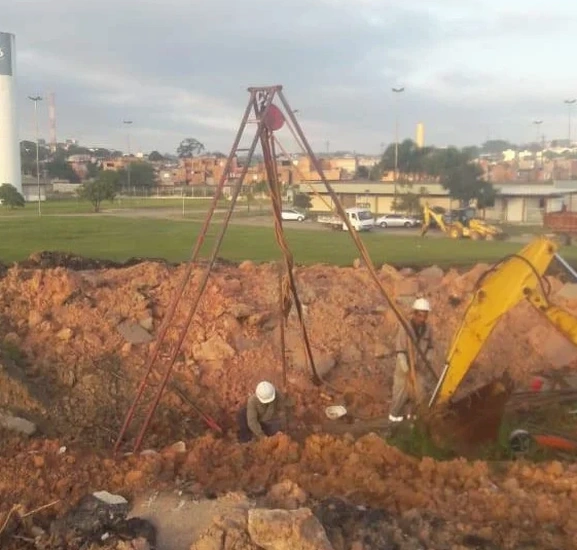
The Thames Valley presents a complex patchwork of London Clay, river terrace gravels, and alluvial silts that challenge even experienced ground engineers. Across Reading, from the redevelopment zones near the station to the business parks along the M4 corridor, the behaviour of cohesive soils depends heavily on moisture content.
When the water table sits high—Readings average annual rainfall exceeds 600 mm, and the Kennet floodplain retains groundwater well into summer—the difference between a stable formation and a problematic soft clay often comes down to the Atterberg limits. Our laboratory determines these critical thresholds with BS 5930 compliance, giving design teams the liquid limit, plastic limit, and plasticity index needed to classify the soil and predict its engineering response before a single pile is driven or footing poured. For projects where deeper stratigraphy is ambiguous, we often recommend pairing this with a CPT test to map the vertical extent of high-plasticity layers.
A plasticity index above 30% in Reading’s London Clay signals high shrink-swell potential—data that directly governs foundation depth recommendations under NHBC Standards.
Local geotechnical context
A recurring mistake on smaller Reading projects is classifying a soil solely by its undrained shear strength from a hand vane or pocket penetrometer, bypassing Atterberg limits entirely. The problem? Two clays with identical shear strength can have completely different plasticity characteristics—one may be a stable low-plasticity kaolinitic clay, the other a highly active smectitic clay that will swell when exposed to water from a leaking drain or broken water main. The latter scenario has triggered costly remedial underpinning on residential extensions in areas like Earley and Lower Earley, where the London Clay interface lies just a few metres below ground level.
Eurocode 7 (BS EN 1997-2:2007) mandates plasticity testing as part of the ground investigation for any structure in cohesive soil, and the NHBC requires Atterberg classification for plots identified as having moderate to high volume change potential. Skipping this £50–£70 test during the desk study phase has, on multiple occasions, led to foundation redesign when shrinkable clay conditions were discovered late in construction.
Common questions
How much does Atterberg limits testing cost for a Reading project?
A standard Atterberg suite (liquid limit, plastic limit, and plasticity index) ranges from £50 to £70 per sample, depending on the number of specimens and whether express turnaround is required. Larger programmes with multiple samples benefit from reduced per-unit pricing.
What is the difference between liquid limit and plastic limit?
The liquid limit is the moisture content at which a soil transitions from a plastic to a liquid state, determined in our laboratory using the cone penetrometer method to BS 1377-2. The plastic limit is the moisture content at which the soil begins to crumble when rolled into a 3 mm thread. The numerical difference between them—the plasticity index—indicates the range of moisture content over which the soil remains workable and is the key parameter for classifying fine-grained soils on the Casagrande chart.
Why are Atterberg limits important for foundations in Reading?
Reading sits on the London Clay Formation, a geological unit known for its high plasticity and shrink-swell behaviour. Atterberg limits supply the plasticity index, which directly correlates with volume change potential. A PI above 30% indicates high shrink-swell risk, triggering deeper foundation depths under NHBC Standards and influencing the choice between trench fill and piled foundations.
How long does the laboratory testing take?
Standard turnaround is three to five working days from sample receipt. We also offer a 48-hour express service for Reading-based projects where site programmes are time-critical. All samples are processed in our UKAS-accredited facility with full traceability maintained throughout.
Do you need undisturbed samples for Atterberg limits testing?
No, Atterberg limits are performed on remoulded soil passing the 425 µm sieve, so disturbed samples are perfectly acceptable. However, the natural moisture content—which requires a separate undisturbed or carefully sealed sample—is needed if you want to calculate the liquidity index and assess the in-situ consistency of the clay.