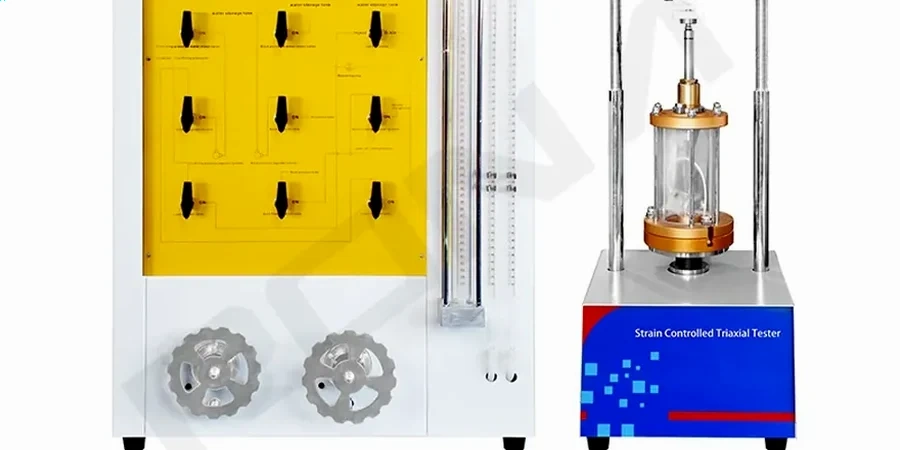
Reading sits on a complex mix of London Clay, river gravels from the Kennet, and pockets of made ground that shift behaviour under load. With over 174,000 residents and major infrastructure like the Reading West Station redevelopment, getting the shear strength right is not optional. A triaxial test gives us the angle of internal friction and cohesion directly from a cylindrical soil specimen, consolidating it under cell pressure and then shearing it until failure. We run consolidated drained (CD) and consolidated undrained (CU) setups depending on whether you need effective stress parameters for long-term slope analysis or total stress for short-term excavation stability. The lab in Berkshire processes samples within 5 working days, and we handle everything from extruding Shelby tubes to selecting the right back-pressure saturation for silty clays that would otherwise give you meaningless results.
A properly saturated triaxial specimen on London Clay will show a B-value above 0.95 before shearing; anything less and your effective stress parameters are guesswork.
Approach and scope
The triaxial cell we use on Reading projects is a Bishop & Wesley type with digital pressure-volume controllers capable of maintaining ±0.1 kPa accuracy during long consolidation phases. A cylindrical specimen, typically 38 mm or 50 mm diameter, sits between porous stones inside a latex membrane. We first saturate it under back-pressure until Skempton's B-value exceeds 0.95, then consolidate isotropically to the in-situ effective stress inferred from site investigation logs. For CD tests on Thames gravels we shear at 0.005 mm/min to let pore water drain freely; for CU tests on London Clay we close the drainage valve and track excess pore pressure through failure. Load cell and LVDT data feed into Mohr-Coulomb plots that yield c' and φ' or cu depending on the drainage condition. Post-test, the specimen is photographed and the failure plane described: barrelling, shear band, or brittle fracture each tell a different story about the soil fabric.
Local geotechnical context
Reading's winter groundwater levels rise fast in the Kennet floodplain, and summer shrinkage in the London Clay formation cracks shallow foundations. If you design with undrained parameters from a quick UU test when your excavation stays open for months, the soil will drain and the strength will change. We've seen projects near the Oracle riverside where CU triaxial tests revealed effective friction angles of 24°, but peak undrained strength dropped by half once pore pressures equalised. Another trap is sampling disturbance in stiff clays; a remoulded specimen loses its structure and gives you a friction angle that looks fine on paper but ignores the brittleness that causes progressive failure in cut slopes. The triaxial test is sensitive to preparation, saturation, and rate effects, and cutting corners on any of these means your factor of safety on a retaining wall or embankment is fictional.
Common questions
What does a triaxial test cost in Reading?
A standard triaxial test package (three specimens at different confining pressures, either CIU or CID) runs between £1,470 and £1,960 depending on specimen diameter, saturation requirements, and turnaround time. Multi-stage tests on a single specimen reduce cost when sample material is limited. Rush processing adds a surcharge but delivers results in 48 hours if the saturation phase goes smoothly.
Which test type do I need: drained or undrained?
It depends on your loading rate and drainage conditions. For long-term slope stability or embankments on Thames gravels, use CD (drained) to get effective stress parameters c' and φ'. For short-term excavation stability in London Clay or rapid drawdown cases, CU with pore pressure measurement gives you both undrained strength and effective stress parameters from a single set of specimens. UU is quick but only useful for total stress analysis in fully saturated clays under immediate loading.
How long does a triaxial test take from sample arrival to report?
Standard turnaround is 5 working days for a three-specimen set. The consolidation phase alone takes 24 to 48 hours for low-permeability clays. Drained shearing at 0.005 mm/min can run another 3 to 5 days. We can expedite to 3 days if you accept a slightly faster shear rate, but for regulatory submissions to the Environment Agency we recommend the standard timeline to keep the data defensible.
What sample quality do you need for reliable triaxial results?
Class 1 undisturbed samples, ideally 100 mm diameter Shelby tubes, taken in accordance with BS EN ISO 22475-1. The sample must be sealed, kept at natural moisture content, and transported in foam-lined boxes without vibration. If the tube shows signs of disturbance — gaps along the wall, water separation, or remoulded zones — we'll document it in the report and flag which parameters should be treated as lower-bound estimates.