← Home · Slopes & Walls

Slope Stability Analysis in Reading: Geotechnical Assessment for Safe Earthworks

Together, we solve the challenges of tomorrow.

LEARN MORE →

In Reading, we regularly encounter slope stability issues where the Lambeth Group sands and clays meet the overlying Thames Valley gravels—particularly along the Kennet floodplain and the steeper ground near Caversham. The interface between these formations is notorious for creating perched water tables and progressive softening that can reduce the factor of safety over time. A desk study alone will not reveal the shear strength parameters needed for a reliable slope stability assessment; it must be paired with targeted ground investigation and laboratory testing. Our team has worked extensively across Berkshire, from minor cut slopes for residential basements in Tilehurst to major highway embankment re-profiling along the M4 corridor. Every Reading site demands a bespoke approach because the local geology shifts within tens of metres, and assuming uniform conditions across the town is one of the fastest ways to underestimate long-term failure risk.

In Reading's Lambeth Group terrain, the difference between a stable cut and a progressive failure is often a 2-degree change in slope angle validated by residual shear strength data.

Methodology and scope

A mistake we see repeatedly in Reading is relying solely on empirical charts or historic borehole data without verifying the residual shear strength through multi-stage triaxial or ring shear testing. When a contractor excavates into weathered London Clay on a slope near the Thames tributaries, the strain-softening behaviour can trigger shallow translational slides that would have been avoidable with proper laboratory characterisation. Our analysis methodology integrates BS 5930:2015+A1:2020 ground investigation protocols with Eurocode 7 Design Approach 1, producing both drained and undrained limit equilibrium models. Where the geology transitions from granular gravels into cohesive clays—common on the northern slopes of the town—we combine the test pits data with borehole-derived samples to map the failure surface geometry accurately. The output is not just a calculation report; it is a phased earthwork strategy that defines permissible slope angles during construction and long-term drainage requirements to maintain the design factor of safety against BS EN 1997-1:2004 requirements.
Slope Stability Analysis in Reading: Geotechnical Assessment for Safe Earthworks
Technical reference image — Reading

Local geotechnical context

The slope conditions between South Reading's developed terraces and the steeper wooded escarpments north of the Thames near Caversham Heights represent two entirely different risk profiles. South Reading sits on relatively flat gravel terraces where slope failure is rare unless deep excavations undermine the gravel-clay interface, whereas the Caversham slopes expose weathered chalk and overlying clay-with-flints that are susceptible to rotational slips after prolonged rainfall. A 2014 winter storm triggered several shallow failures along the A4155 corridor, demonstrating how pore pressure buildup in the upper 2–3 metres can reduce the factor of safety below unity within hours. For infrastructure projects near Reading's railway embankments—many built in the Victorian era without engineered drainage—we apply back-analysis using Spencer's method to calibrate strength parameters against observed performance. Ignoring the hydrogeological complexity of the Reading Formation means accepting a failure probability that is incompatible with Network Rail and National Highways asset management standards.

Need a geotechnical assessment?

Reply within 24h.

Email: contact@geotechnical-engineering1.com

Technical parameters

ParameterTypical value
Peak effective friction angle (φ')Determined via consolidated-drained triaxial on intact samples, typically 22°–32° for local clays
Residual friction angle (φ'r)Measured by ring shear apparatus per BS 1377-7, critical for pre-existing shear surfaces
Cohesion intercept (c')Evaluated from multi-stage testing, often 0–5 kPa for fissured Reading clays in the long term
Pore pressure ratio (ru)Modelled from piezometer arrays; seasonal variation of 0.15–0.35 in Thames Valley slopes
Minimum factor of safety (FoS)1.3 for temporary works, 1.5 for permanent slopes under static conditions per BS EN 1997-1
Seismic coefficient (kh)0.015–0.025 for pseudo-static analysis, reflecting UK seismicity per BS EN 1998-5
Permeability (k)10⁻⁶ to 10⁻⁹ m/s range tested by in-situ permeability methods in gravels and clays respectively

Related services

01

Limit Equilibrium Modelling and Parameter Selection

We build 2D and 3D models using Bishop, Spencer, and Morgenstern-Price methods, populated with shear strength parameters derived from our UKAS-accredited laboratory testing programme. The process includes sensitivity analysis on pore pressure distribution and strength anisotropy, producing design envelopes that inform earthwork specifications and temporary works design.

02

Stabilisation Design and Construction Monitoring

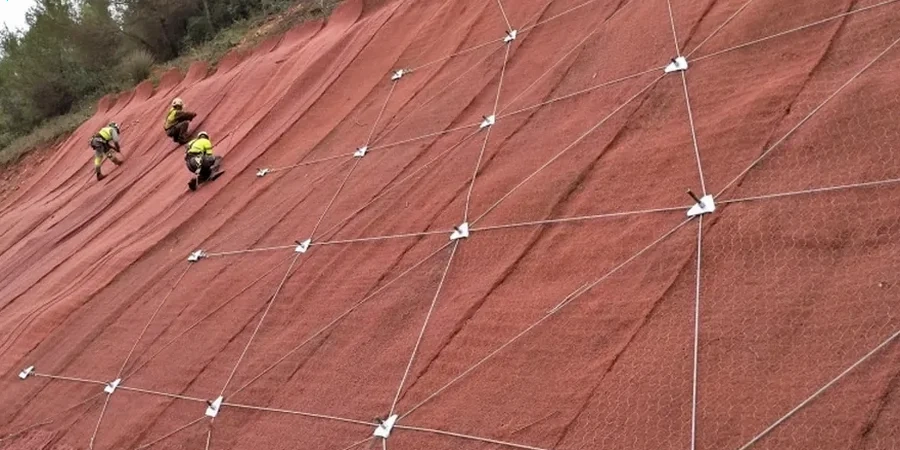
Where existing slopes fall below the required factor of safety, we design soil nailing, anchored mesh systems, or regrading solutions in accordance with BS 8006-1:2010. Installation is supported by excavation monitoring during the works and inclinometer verification to confirm that ground movement stays within the predicted range.

Relevant standards

BS 5930:2015+A1:2020 – Code of practice for ground investigations, BS EN 1997-1:2004 (Eurocode 7) – Geotechnical design – General rules, BS EN 1997-2:2007 – Ground investigation and testing, BS EN 1998-5:2004 – Design of structures for earthquake resistance – Foundations, retaining structures, BS 1377:2022 – Methods of test for soils for civil engineering purposes

Common questions

What ground investigation is needed before a slope stability analysis in Reading?

A compliant investigation under BS 5930:2015+A1:2020 typically requires cable percussive or rotary boreholes with sampling at depth intervals no greater than 1.5 metres, plus trial pits to expose the near-surface geology. In Reading, we also install standpipe or vibrating-wire piezometers to monitor groundwater levels over at least one wet season, because the Thames Valley gravel aquifer can produce artesian conditions that significantly alter pore pressure assumptions.

How much does a slope stability analysis cost for a project in Reading?

For a site in Reading, costs range from £930 for a desktop review and simple infinite-slope calculation on a small residential plot, up to £3,590 for a full investigation including borehole supervision, multi-stage triaxial testing, limit equilibrium modelling, and a detailed interpretive report. The final figure depends on slope height, geological complexity, and the number of cross-sections requiring analysis.

Which failure criteria apply to engineered slopes under UK design standards?

Under Eurocode 7 (BS EN 1997-1:2004), permanent slopes must achieve a minimum factor of safety of 1.5 for drained conditions and 1.3 for temporary works. We also check serviceability limit states by limiting horizontal displacements to values compatible with nearby structures and utilities, referencing CIRIA C760 guidance on acceptable movement thresholds for buried assets.

Can you analyse slopes in weathered chalk, which is common north of Reading?

Yes. Weathered chalk presents a structured material with brittle behaviour controlled by discontinuity spacing and infill properties. Our approach combines rock mass classification (using the Geological Strength Index) with laboratory unconfined compressive strength tests to define a Hoek-Brown failure envelope, then transitions to a Mohr-Coulomb equivalent for limit equilibrium software. The key challenge north of Reading is the putty chalk layer at the weathering front, which can act as a low-shear-strength horizon during wet winters.
Location and service area

We serve projects in Reading and surrounding areas.

View larger map