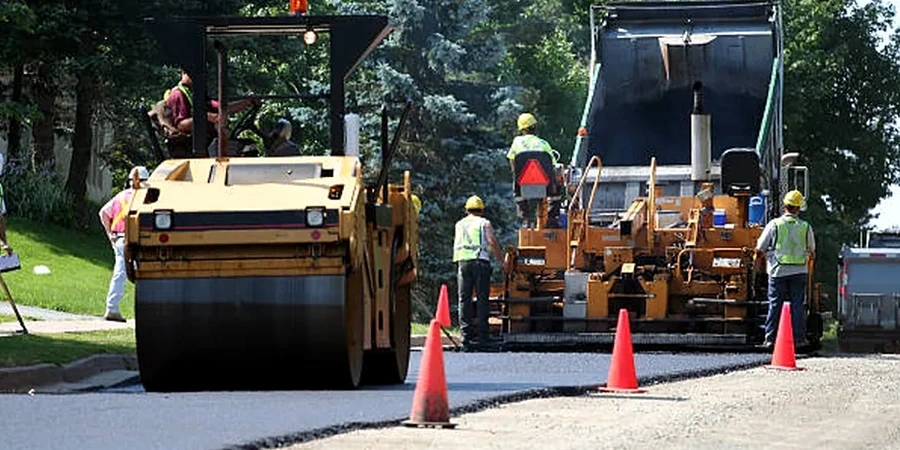
The Thames Valley presents a particular set of challenges for road and car park construction across Reading. Alluvial gravels, pockets of soft clay, and the London Clay Formation that underlies much of the town create a subgrade that demands careful evaluation before any pavement layer is specified. A flexible pavement design that works perfectly on the chalk of the Chilterns will fail prematurely if dropped onto the water-sensitive clays found south of the River Kennet without adjustment. Our technical team approaches each project by correlating the ground investigation data—from dynamic cone penetrometer readings to laboratory CBR values—with the anticipated traffic loading over the design life. The objective is a pavement structure that distributes stress efficiently through the bituminous bound layers into the capping and subgrade without excessive deformation. In a town with Reading's mix of Victorian terraces and modern commercial parks, this often means tailoring the CBR road design parameters to match the specific formation level conditions encountered on site, rather than relying on generic county-wide assumptions.
A pavement is only as good as its subgrade—in Reading's London Clay, getting the capping and drainage right determines whether you get 20 years or 5.
Local geotechnical context
BS EN 1997-2 mandates that ground investigation must supply sufficient data for the design situation, and in Reading this has a very specific implication for flexible pavement design: failing to identify and characterise the boundary between the River Terrace Deposits and the underlying London Clay is a frequent source of pavement failure. Where a pavement section straddles this geological boundary, differential settlement can open transverse cracks within the first two years of service, allowing water ingress that accelerates structural degradation from the subgrade upwards. The design risk is compounded by Reading's seasonal groundwater fluctuations, particularly in the floodplain areas south of the Thames, where a winter water table rise can saturate granular sub-base materials that were designed assuming drained conditions. Our design process explicitly addresses this by specifying subgrade drainage details and, where necessary, incorporating a separation geotextile to prevent fine clay migration into the open-graded sub-base. For commercial developments, the liability of premature pavement failure—disruption to business operations, trip hazards, and the cost of full-depth reconstruction—far exceeds the investment in a site-specific pavement design backed by adequate ground investigation data.
Relevant standards
BS 5930:2015+A1:2020 Code of practice for ground investigations, Eurocode 7 – Geotechnical design (BS EN 1997-1:2004 and BS EN 1997-2:2007), DMRB CD 225 – Design for new pavement construction (formerly IAN 73/06), BS EN 13108 series – Bituminous mixtures material specifications, Manual of Contract Documents for Highway Works (MCHW), Series 600, 700, 800, 900
Common questions
How much does a flexible pavement design for a Reading project typically cost?
For a site-specific flexible pavement design in Reading, including ground investigation data review, analytical modelling and a design report with construction specifications, the fee generally falls between £1,260 and £4,150 depending on the pavement area, traffic loading complexity, and whether new site investigation data is required. A straightforward car park design on a well-characterised site sits at the lower end; a heavily trafficked industrial road with marginal subgrade conditions requiring detailed CBR assessment and multiple design sections will be priced at the upper end of that range.
What makes flexible pavement design in Reading different from other UK locations?
Reading's geology sits at the western edge of the London Basin, meaning the London Clay subgrade is often shallower and more variable than further east. The River Terrace Deposits that cap much of the town supply excellent bearing when dry but are prone to saturation where the underlying clay creates a perched water table. A pavement design for Reading must account for this groundwater sensitivity and the potential for subgrade CBR values to drop significantly between summer construction and winter service conditions. Our designs always use soaked CBR values as the baseline, and we pay particular attention to drainage detailing around the pavement edges.
What traffic data do you need to start the pavement design?
We require the anticipated commercial vehicle flows over the design life—ideally broken down by vehicle class if available—or at minimum an estimate of the cumulative millions of standard axles (msa) the pavement must sustain. For new developments in Reading, this often comes from the transport assessment prepared for the planning application. We also need to know the design life (typically 20 or 40 years for roads, less for car parks) and any special requirements such as bus stops, turning areas, or frequent HGV loading bays where channelised traffic may require a heavier-duty specification.