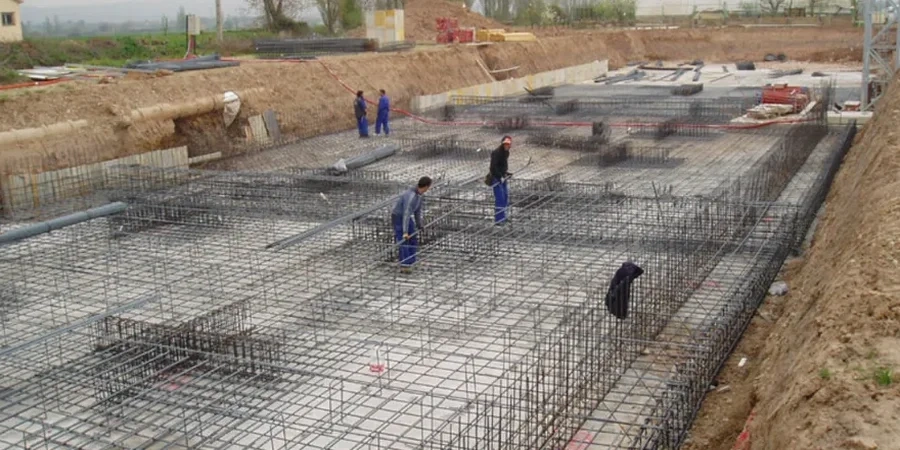
Reading's expansion from a modest Saxon settlement at the confluence of the Thames and Kennet into a major Thames Valley hub has left a patchwork of ground conditions. The town centre sits on River Terrace Gravels overlying the London Clay Formation, while the southern suburbs climb onto the Bagshot Sands of the Berkshire plateau. Victorian railway cuttings and post-war redevelopment of the old Huntley & Palmers biscuit factory site have created extensive made ground zones where buried foundations and backfilled pits are common. We encounter these surprises during routine site investigation. A shallow foundation design that ignores this urban stratigraphy is a liability. Before placing footings, we correlate borehole logs with the CPT test to map soft clay lenses that standard SPTs may smear, and we use the plate load test on granular fills where undisturbed sampling is impractical, giving the structural engineer a reliable modulus of subgrade reaction for Reading's variable ground.
A weathered London Clay crust in Reading can lose 40% of its stiffness within the upper 2 metres; ignoring this desiccation zone is the fastest way to a differential settlement claim.
Local geotechnical context
We use a 200 kN capacity plate load test rig, a modular steel reaction frame anchored against a loaded excavator or a kentledge of concrete blocks. On a recent project near the IDR, the rig revealed a 60% drop in bearing stiffness across a 4-metre transect. The cause was a Victorian brick-lined well, backfilled with ash and clinker, missed by the trial pits. The structural engineer had designed a continuous strip footing at 150 kPa bearing pressure; the plate test showed settlement exceeding 25 mm at half that pressure directly over the backfill. We halted the pour, shifted the column line by 1.8 metres, and saved the client a costly underpinning exercise. Shallow foundation design in Reading demands this level of site-specific verification because the historical ground disturbances are neither mapped nor predictable. The plate load test data feeds directly into the settlement calculation, replacing empirical modifiers with measured deformation moduli.
Common questions
What is the typical cost of a shallow foundation design package for a residential extension in Reading?
For a single-storey rear extension on a typical Reading terrace plot, our combined ground investigation and shallow foundation design package ranges from £1,340 to £2,430. The price depends on access constraints, the number of trial pits or boreholes required, and whether a plate load test is specified. Clay soils in the Caversham area often need deeper investigation than the gravel terraces south of the river, which affects the final figure.
How deep do footings need to be in Reading's London Clay to avoid the desiccation zone?
We typically specify a minimum founding depth of 1.0 to 1.2 metres for strip footings on London Clay in Reading. This takes the bearing level below the zone of seasonal moisture fluctuation and most of the weathered, fissured crust. However, the exact depth depends on the plasticity index measured in the lab: high-plasticity clays (PI above 40%) may require an additional 200 to 300 mm to reach intact material with consistent undrained shear strength.
Do you need to consider sulfate attack for shallow foundations in Reading?
Yes, and it is a critical design input. The London Clay across the Reading area frequently classifies as DS-3 or AC-3s according to BRE Special Digest 1, indicating high sulfate content and an acidic pH. This requires sulfate-resisting cement and a higher concrete quality for buried footings. We sample and test the soil chemistry as part of every shallow foundation design and specify the Design Sulfate Class directly on the foundation drawings.
What is the difference between a plate load test and a standard bearing capacity calculation from a borehole log?
A bearing capacity calculation from a borehole log relies on laboratory strength parameters from a limited number of samples and applies a global factor of safety. A plate load test measures the actual load-deformation behaviour of the ground at the exact founding level, at a scale close to a real footing. In Reading's variable made ground and weathered clay profiles, the plate test frequently reveals stiffness anomalies that a borehole-based calculation would miss, allowing us to adjust the foundation width or depth before concrete is poured.