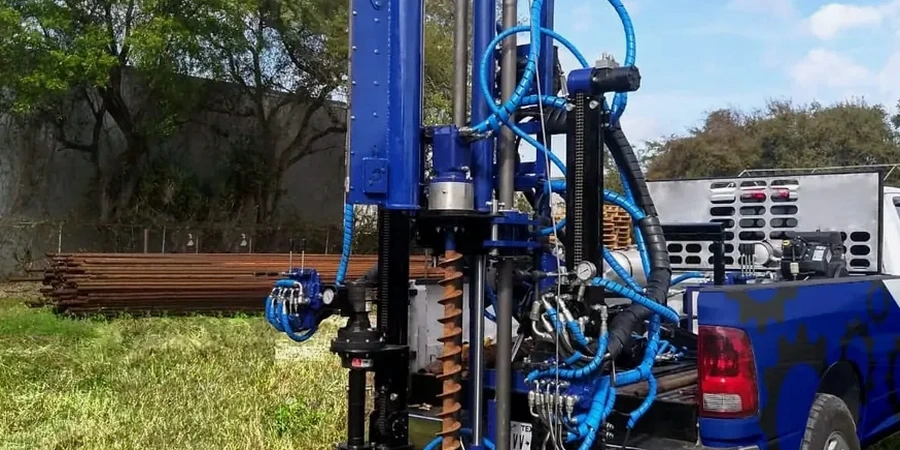
Beneath Reading's streets, the geology shifts from the stiff, overconsolidated London Clay on higher ground to loose alluvial sands and gravels along the Kennet and Thames floodplains. This contrast creates distinct bearing capacity challenges within a single postcode. A standard penetration test provides the numerical backbone for any foundation design here, translating hammer blows into quantifiable soil strength. The SPT remains the most widely specified in-situ test under BS 5930:2015, and for good reason: it recovers a disturbed sample while recording the resistance of the ground. For engineers working near the Oracle shopping centre or on the redevelopment plots around Reading West station, understanding the N-value profile is not a formality; it is a cost-control measure that prevents over-design or, worse, unexpected settlement in granular lenses. We run the split-spoon sampler through the full depth of influence, and when the gravels of the Taplow Terrace appear, the drive count tells the story that a borehole log alone cannot.
An SPT N-value is not just a number: it is the soil's direct response to a standardised energy input, and in Reading's mixed ground, it prevents the costly assumption of uniformity.
Local geotechnical context
A residential block on Caversham Road was designed with a presumptive bearing capacity of 100 kPa, but the SPT returned N-values of 6 to 8 in the upper four metres: loose alluvium that had not been mapped in the desk study. The structural engineer reduced the allowable pressure and specified a wider mat foundation to distribute the load, avoiding differential settlement that would have cracked the brickwork within two years. The risk in Reading is not always the deep clay; it is the unmapped paleochannels filled with soft organic silt and peat, remnants of old Thames meanders now buried under Victorian terraces. An SPT rig that stops at refusal on a gravel band may miss a compressible layer beneath, so we log every run and never assume homogeneity. The N-value also feeds directly into liquefaction potential assessments for seismic events, and although Reading sits in a low-seismicity zone, the 2008 Market Rasen earthquake reminded southern England that dormant faults can wake.
Common questions
How much does an SPT borehole cost in Reading?
A single SPT borehole to 10 metres depth in Reading typically falls between £490 and £550, including the rig, operator, engineer logging, and a factual report. Deeper holes, restricted access sites in the town centre, or multiple boreholes on the same day reduce the unit cost. We supply a fixed-price quotation after reviewing the site location and ground conditions.
How many SPT boreholes do I need for a house extension in Reading?
For a typical two-storey rear extension on London Clay, one borehole to 6–8 metres may suffice if the ground is uniform. However, if your property is near the floodplain or on made ground, we recommend two boreholes at opposite corners to capture lateral variability. The final number should be agreed with your structural engineer and building control officer.
What is the difference between SPT and a window sample borehole?
A window sample borehole uses a smaller diameter sampler driven by a hydraulic hammer, typically to 5 metres depth, and is suitable for shallow investigations in cohesive soils. The SPT uses a standardised 50 mm split-spoon sampler with a 63.5 kg hammer dropping 760 mm, producing an N-value that correlates with published bearing capacity and settlement methods. SPT goes deeper and provides data accepted by all UK structural engineers and insurers.