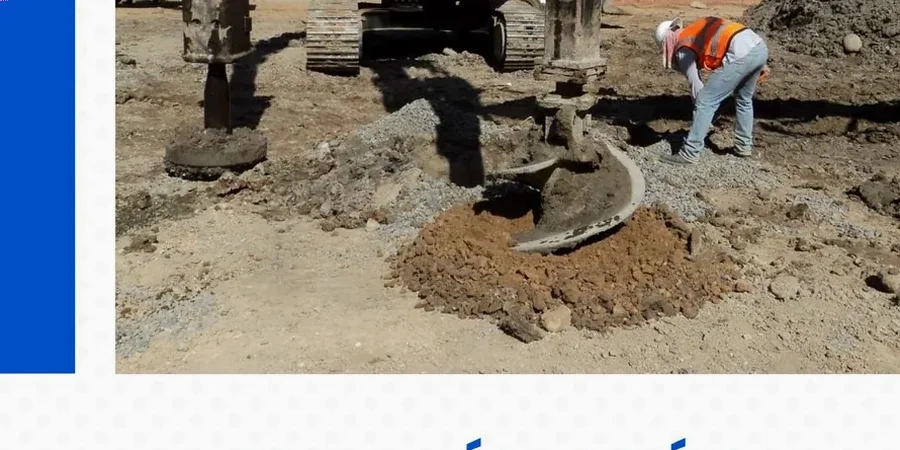
The Kennet Valley's alluvial history left Reading with pockets of soft clay and peat that challenge conventional foundations. The Thames tributaries deposited compressible soils across the town centre and south toward the M4 corridor. A standard footing on this ground risks differential settlement within months. We address this with vibro stone column design. Our approach reinforces the weak matrix with compacted granular columns that densify surrounding soil and drain excess pore pressure. Each array is modelled from site-specific CPT data to match the structural load and settlement tolerance. For deep alluvial sequences near the River Kennet, we verify column stiffness with a plate load test on a trial column before full production.
A well-designed stone column grid turns compressible alluvium into a drained, densified foundation medium without the carbon cost of deep piling.
Approach and scope
Reading's expansion from a Saxon river crossing into a Thames Valley tech hub left a legacy of buried obstructions and variable fill. Victorian railway yards, demolished breweries, and post-war industrial sheds created a patchwork of made ground. Stone columns bridge this heterogeneity. We design end-bearing or floating columns depending on competent stratum depth. The installation process displaces soil laterally, increasing horizontal stress and creating a composite ground mass with improved modulus. Our mix designs use angular aggregate graded to BS EN 933-1. Column diameter, spacing, and depth come from a settlement analysis under the project's serviceability limit state. We target a reduction ratio that keeps post-construction settlement within 25 mm for typical commercial slabs.
Common questions
What is the typical cost range for stone column design in Reading?
For a full design package including ground model review, settlement analysis, and installation specification, the fee ranges from £1,260 to £4,340 depending on site size and load complexity. This covers the engineering deliverable; aggregate and rig mobilisation are separate.
How deep can stone columns be installed in Thames Valley soils?
We routinely design columns to 15 m depth in the Kennet floodplain. The limiting factor is usually the reach of the vibroflot mast and the presence of dense gravel at the London Clay interface, which serves as an ideal bearing stratum.
Which ground conditions in Reading benefit most from stone columns?
Soft to firm alluvial clays, loose silty sands, and anthropogenic made ground respond best. Stone columns are less effective in peat thicker than 1 m without preloading or a load transfer platform. We assess organic content from borehole logs before recommending the technique.