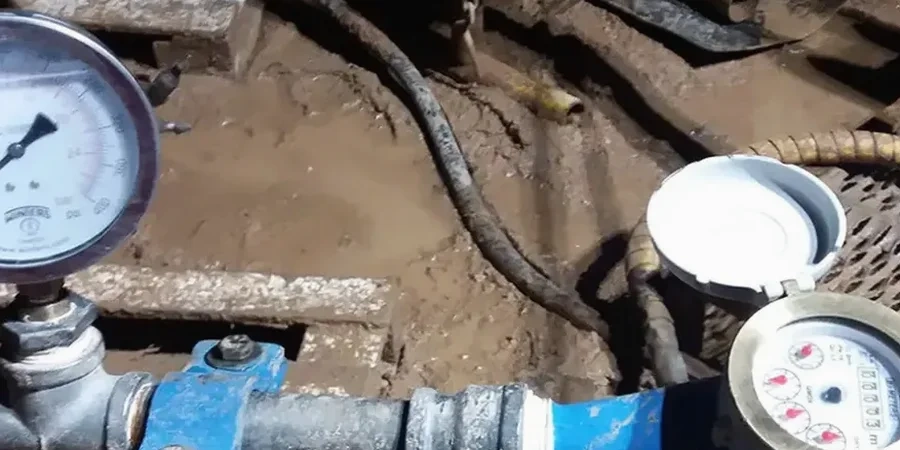
Reading sits at roughly 45 metres above sea level, where the River Thames and its tributary the Kennet shape the local water table more than most developers anticipate. We have reviewed borehole logs across the RG postcode area where near-surface alluvium overlies the Reading Formation clays, and the perched groundwater often catches foundation design off guard. A field permeability test using Lefranc or Lugeon procedures removes that guesswork, delivering the hydraulic conductivity values that drainage engineers and structural designers actually need. Our laboratory operates under UKAS-accredited procedures, executing BS 5930 compliant tests that feed directly into Eurocode 7 (BS EN 1997-2:2007) design scenarios for retaining walls, deep excavations, and cut-and-cover infrastructure.
In the Thames Valley, a single Lefranc test at foundation depth can reveal perched water that completely changes the excavation support design.
Local geotechnical context
A project near the Reading IDR involved a basement excavation where the contractor assumed the Lambeth Group sands would be dry based on a single borehole log from the preliminary investigation. During construction, a thin gravel lens intercepted groundwater from the Kennet floodplain, and the inflow rate overwhelmed the sump pumps within hours. The client lost three weeks of programme while we mobilised to run Lefranc tests at multiple horizons, which revealed a perched aquifer at 4.2 metres depth with a permeability two orders of magnitude higher than the surrounding strata. The revised dewatering design required deepwell systems instead of the originally specified wellpoints, and the additional cost ran into six figures. In our background across Berkshire, the cost of a field permeability test programme upfront rarely exceeds the contingency spend that projects burn through when groundwater surprises appear mid-excavation.
Common questions
What is the difference between a Lefranc test and a Lugeon test?
A Lefranc test measures permeability in soils and very weak rock by injecting or extracting water through an open borehole section, typically under low pressure, and is suited to granular or cohesive strata. A Lugeon test is designed for fractured rock and uses a packer to isolate a section of borehole, injecting water at stepped pressures to assess rock mass permeability in Lugeon units. In Reading, we typically use Lefranc in the Lambeth Group sands and Lugeon in the Chalk bedrock, following the procedures set out in BS EN ISO 22282-2.
How much does a field permeability test cost in Reading?
For a standard Lefranc or Lugeon test programme in the Reading area, budget between £540 and £730 per test point, depending on depth, access conditions, and the number of tests required. A full investigation with multiple test horizons will naturally fall at the upper end of the range. We supply fixed-price quotations after reviewing your site location and ground investigation specification.
How long does it take to get results from a permeability test?
The field execution of a single Lefranc or Lugeon test generally takes between one and two hours once the borehole is advanced, excluding rig setup. We deliver factual data within two to three working days of site completion, and an interpretative report with k-values and dewatering recommendations follows within five to seven working days, depending on the number of test points and the complexity of the ground conditions.
Which standard governs permeability testing for UK projects?
Field permeability testing in the UK is governed principally by BS 5930:2015 + A1:2020, with additional procedural detail provided in BS EN ISO 22282-2:2012. For design purposes, the results feed into the ground investigation framework of Eurocode 7 (BS EN 1997-2:2007). Our laboratory operates under UKAS accreditation, ensuring full traceability and compliance with Network Rail, Environment Agency, and NHBC requirements.