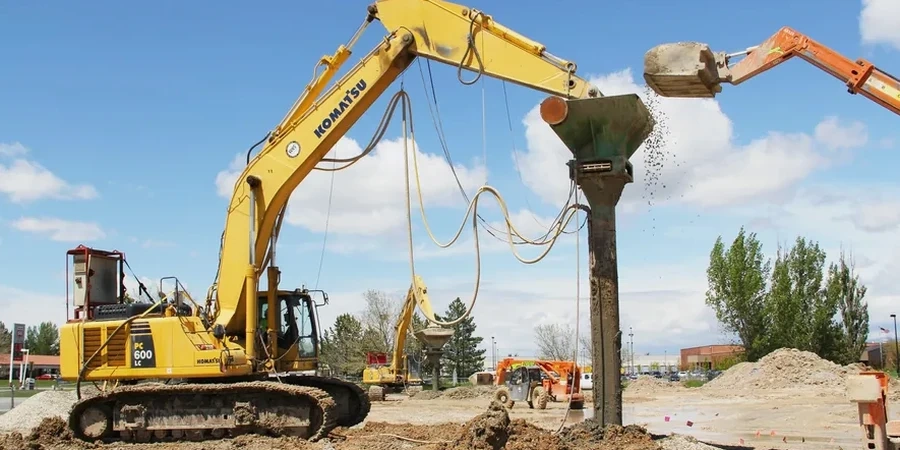
In Reading, we see it time and again—granular fills and natural sands that look competent at surface but fail to meet settlement criteria under load. The London Clay might grab the headlines, but the real challenges here sit in the River Terrace Deposits. These soils, spread across the Kennet floodplain, are loose and variable. Standard compaction methods barely scratch the surface. Deep vibratory compaction, properly designed, changes the game entirely. We specify vibrator power, grid spacing, and stage durations based on site-specific gradings, not generic charts. The difference between a floor slab that stays level for decades and one that cracks within two years often comes down to the CPT testing we use to calibrate the design and verify improvement depth.
A vibrocompaction grid is only as good as its calibration. Without pre-treatment CPT profiles, you are flying blind.
Local geotechnical context
Reading's position in the Thames floodplain means groundwater is never far beneath your feet. The winter months push the water table even higher, and that is when poorly designed compaction schemes unravel. Excess pore pressure builds during vibration, and if the drainage path is too long or the soil too silty, the whole grid loses efficiency. You end up with a beautifully compacted crust over loose material. That is a settlement liability waiting to happen. We factor in drainage stage timing explicitly—something generic designs skip. Another local risk is buried chalk dissolution features beneath the gravels, which can create sudden depth variations. Without a dense CPT grid before design, you miss these. The cost of remediation after construction dwarfs the cost of proper site investigation.
Common questions
What soil types in Reading are suitable for vibrocompaction?
River Terrace Deposits dominate the suitable profile. We need granular material with fines content below 12 percent, ideally gravelly sands or sandy gravels. The London Clay underneath is not treatable by vibration alone—for those cohesive layers we switch to stone columns or rigid inclusions.
How much does vibrocompaction design cost for a typical Reading project?
Design packages range from £1.310 for a small single-building footprint up to £3.620 for large commercial plots requiring detailed grid optimisation, drainage analysis, and full QC specification. Every quote is project-specific—the number of CPT points and treatment depth drive the engineering input.
What depth of compaction can we expect?
With a 130 kW electric vibrator and favourable granular conditions, effective treatment reaches 18 to 25 metres. The limiting factor is usually groundwater—above the water table efficiency drops, so we specify water flushing when working in the dry upper gravels.
How do you verify the compaction has worked?
We specify a before-and-after CPT campaign. Cone resistance should increase by a factor of 1.5 to 2.5 depending on initial density. For critical structures, we also run a zone load test on a completed compaction point to confirm modulus improvement.
Is vibrocompaction a noisy process? Will it affect nearby buildings in Reading?
Yes, it generates ground-borne vibration. We assess peak particle velocity against BS 5228-2 thresholds for sensitive structures. In dense urban areas like central Reading, we reduce vibrator power near existing buildings and monitor with seismographs. It is manageable with proper planning.