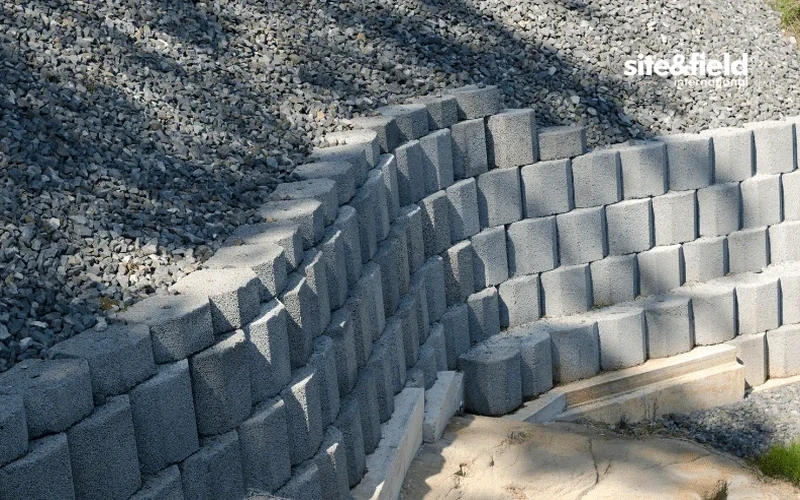
Reading's topography isn't flat. Drive along the A329 or through Caversham and you'll see why retaining walls are a recurring necessity rather than an afterthought. Many sites sit on the boundary between the Thames floodplain gravels and the weathered London Clay that underlies much of the town. We see projects every month where a standard gravity wall would fail because the designer assumed uniform ground conditions. The reality is different: a cut of two metres can expose three distinct soil layers with completely different drainage and pressure profiles. That is where our retaining wall design comes in. We combine geotechnical data from in-situ permeability tests with accurate strength parameters to size the stem, check overturning, and detail the drainage — because in Reading, a blocked weep hole means a failed wall within two winters.
A retaining wall in Reading lives or dies by its drainage — London Clay doesn't forgive water trapped behind the stem.
Local geotechnical context
Reading expanded rapidly along the Thames and Kennet valleys during the Victorian railway boom, and much of that growth happened on made ground or reworked alluvium. Old brick pits were backfilled, stream channels diverted, and terraces built up without modern compaction control. When we design a retaining wall today on a site near the town centre or along the Oxford Road corridor, we assume nothing about the ground until the trial pits are open. The biggest risk is differential settlement behind the wall, which can crack the stem or snap the drainage pipe. A second risk is softening of the London Clay at the toe if the excavation is left open too long during wet weather — we specify blinding concrete within 24 hours of final excavation. For walls exceeding 2.5 m in height, we also run a slope stability analysis to confirm that the wall is not sitting on a pre-existing failure surface that could reactivate under construction loading.
Common questions
Do I need Building Regulations approval for a retaining wall in Reading?
In most cases, yes. Under the Building Regulations 2010, walls retaining more than 1.2 m of ground difference and located closer than 1.2 m to a boundary or building typically require structural design sign-off. Exemptions exist for some garden landscaping, but the safest approach is to submit our design calculations with your Building Control application. Reading Borough Council's Building Control team can confirm site-specific requirements.
What does retaining wall design cost for a typical Reading residential project?
For a standard residential wall between 1.5 m and 3.5 m in height, our design fee ranges from £930 to £3,190 depending on ground complexity, the number of trial pits we need to excavate, and whether reinforcement or global slope stability checks are required. A simple free-standing garden wall on gravel falls at the lower end; a basement retaining wall in London Clay with surcharge from an adjacent building moves toward the upper end.
How long does the design process take from site visit to issued drawings?
A straightforward project typically takes three to four weeks. Week one: site visit and trial pit excavation. Week two: laboratory testing (classification, shear strength). Week three: design calculations and drafting. Week four: internal review and issue. Complex walls involving slope stability or reinforced earth may add one to two weeks. We can fast-track to two weeks for urgent projects when testing capacity allows.
Can you design retaining walls on the London Clay slopes common in Caversham?
Yes — Caversham's sloping sites on London Clay are exactly the type of ground we work on regularly. The key challenge is managing surface water runoff from higher ground and preventing softening of the clay at the wall toe. We specify deeper foundations, under-drainage, and sometimes a granular raft behind the wall to intercept groundwater. Slope stability analysis is standard for any Caversham wall over 2.5 m in height.