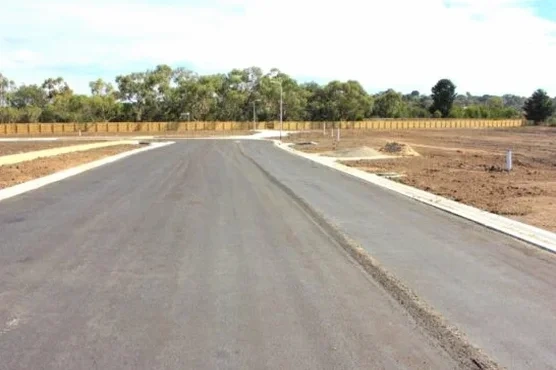
Reading sits on the Thames Valley floodplain, where the Lambeth Group clays and river terrace gravels create a tricky subgrade for heavy-duty pavements. Winter saturation swells the clay beneath the concrete slab, while summer shrinkage opens micro-gaps under the base. A rigid pavement transfers wheel loads through flexural strength, not by spreading them in a granular pyramid, so any loss of uniform support concentrates stress at the slab edge. The design must lock the k-value to a spring thaw scenario, not a dry August snapshot. We combine the plate load test to capture the in-situ modulus of the upper gravels with the CBR test where the formation level cuts into weathered clay, giving the structural designer a ground model that respects the seasonal water table swing beneath the Kennet Valley.
A concrete slab on the Thames Valley clays needs its k-value modelled for the wettest month, not the driest.
Local geotechnical context
The Reading Formation clay shrinks and swells with a seasonal amplitude that can lift a lightly loaded slab corner by 12 millimetres. That movement may sound trivial, but it is enough to crack a 200-millimetre concrete panel if the curling stress adds to the traffic-induced tensile strain at the top of the slab. Pumping is the second failure mechanism: water trapped in the subbase under a poorly drained joint ejects fines every time a heavy goods vehicle axle passes, eroding the support beneath the slab centre. On the M4 distribution roads and the Green Park business estate, we see fatigue cracking accelerate when the drainage layer is omitted. Our site investigation quantifies the depth to the permanent water table, the permeability of the formation, and the frost susceptibility of the capping, so the pavement engineer can detail a drainage system that keeps the granular layer free-draining for the 40-year design life.
Common questions
What is the typical cost range for a rigid pavement geotechnical investigation in Reading?
The investigation cost ranges from £1,690 to £5,530 depending on the number of plate load tests, boreholes, and laboratory resilient modulus cycles required. A small car-park assessment sits at the lower end, while a full highway scheme with multiple CBR points and triaxial testing moves toward the upper figure.
Which Eurocode clause governs the ground investigation for concrete pavements?
BS EN 1997-1:2004 Section 3 covers geotechnical data, while BS EN 1997-2:2007 Part 2 guides field and laboratory testing. The UK National Annex to BS EN 1997-1 provides additional provisions for determining the modulus of subgrade reaction under saturated conditions.
How deep should a borehole go for a rigid pavement design in the Reading area?
The borehole depth depends on the formation. Over the river terrace gravels, 3 to 4 metres below proposed formation level is usually sufficient. On the London Clay sites south of the M4, we extend to 6 metres to capture the depth of the seasonal moisture-active zone and check for any sand lenses that could act as a perched water source under the slab.
Does the London Clay in Reading require lime stabilisation under a concrete pavement?
Often yes. The high plasticity London Clay loses shear strength rapidly when wet, so a cement- or lime-stabilised capping layer of 250–350 millimetres is common. We test the sulphate content first, because some Reading clays contain enough pyrite to trigger sulphate attack on cement-bound materials, which would demand a sulfate-resisting cement or a switch to a mechanical stabilisation approach.