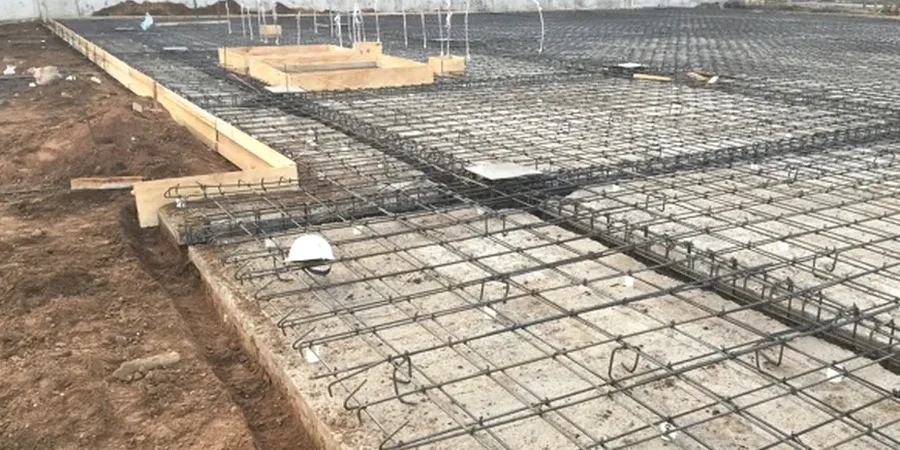
The heavy rigs we mobilise across the M4 corridor tell you a lot about the ground beneath Reading. Before any raft design leaves our office, a tracked CPT unit or dynamic probing rig is usually on site, pushing through the made ground that blankets much of the town centre and the Thames Valley floodplain. We work with the Tertiary London Clay and the overlying river terrace gravels, and the interface between them dictates foundation behaviour. A mat foundation isn't a generic slab: in Reading it has to reconcile the stiff clay at depth with the looser silts and gravels near the surface, and our team handles that from the first borehole log right through to the reinforcement schedule.
The difference between a raft that works and one that cracks is often the stiffness profile between the gravel and the London Clay — and that's exactly what we measure.
Approach and scope
In Reading, many of the post-war commercial buildings along the A329 corridor sit on variable fill that was never engineered to modern standards, and we see the consequences during redevelopment geotechnics. The key parameter we chase early is the modulus of subgrade reaction, which we derive from plate load tests or back-calculate from CPT tip resistance. A well-proportioned raft distributes column loads so that differential settlement stays within the angular distortion limits of BS EN 1997-1:2004. We model the soil-structure interaction using Winkler spring idealisations or continuum finite element models when the rigidity of the superstructure demands it.
Our Reading projects often trigger a combined approach: we correlate in-situ test results with laboratory consolidation and triaxial data to build a ground model that is credible to both the NHBC and the local authority building control. Where the gravel is thin, we check punching shear at column heads; where it's thick, we verify that seasonal moisture changes in the underlying clay won't induce edge heave. The
CPT test data is especially useful here, because it gives us a near-continuous stiffness profile that borehole sampling alone cannot deliver, and that profile feeds directly into the settlement trough calculations.
Local geotechnical context
BS EN 1997-1 requires that the design of a raft foundation consider not only ultimate bearing capacity but also serviceability limit states, and in Reading the serviceability check often governs because of the London Clay's sensitivity to moisture. Even a modest water leak from a broken drain can soften the clay under a slab corner and trigger differential movement that a purely structural analysis would miss. We've seen unreinforced rafts on the western edge of town, around Tilehurst, suffer distress when founded on desiccated clay that later rehydrated after construction, confirming what Burland's work on stiff clays predicted. Our design approach prescribes a solid groundwater monitoring programme during the investigation phase, and we specify under-slab drainage and sulphate-resistant concrete where the BRE Special Digest 1 classification demands it. Ignoring the long-term groundwater regime — especially in the Kennet Valley where the water table can rise sharply in winter — turns a calculated risk into a real liability.
Common questions
What is the typical cost range for a raft foundation design in Reading?
For a standard residential or light commercial raft foundation in Reading, the design fee typically falls between £750 and £3,070, depending on the building footprint, the complexity of the ground conditions, and the number of level of structural analysis required. Projects involving deep basements, very poor ground, or complex superstructure geometry will be at the upper end of that range.
When is a raft foundation a better choice than strip footings in Reading?
A raft becomes the logical choice when the allowable bearing pressure of the near-surface soils is low — common where loose alluvium or soft made ground overlies the gravel — or when strip footings would cover more than 50% of the building footprint. It also reduces differential settlement risk on variable ground, which is frequent across the Thames Valley sections of Reading.
How do you determine the modulus of subgrade reaction for a Reading site?
We derive the modulus primarily from plate load tests carried out at formation level, and we cross-check the values with correlations from CPT cone resistance and SPT N-values where appropriate. The number and location of tests follow BS 5930 recommendations, and we adjust the secant modulus for foundation size and shape before it enters the structural model.
What investigation depth is required for a raft foundation in London Clay?
For a raft on the London Clay in Reading, we typically investigate to a depth of at least 1.5 times the raft width below formation level, or to the depth where the stress increase drops below 10% of the existing overburden pressure. This often means boreholes extending 15 to 25 metres below ground level, penetrating through the clay into the Lambeth Group sands to confirm the full stratigraphy and groundwater conditions.