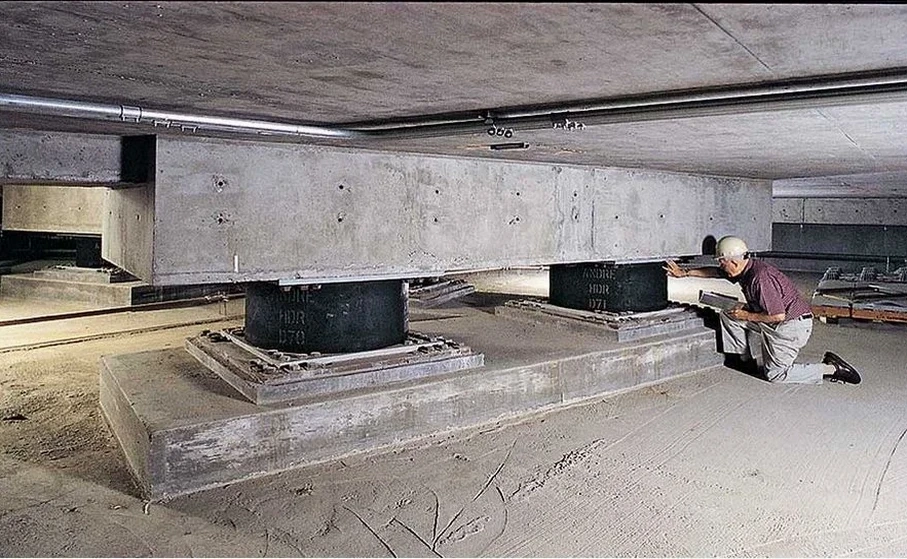
Reading sits on a complex mix of London Clay, river terrace gravels, and Lambeth Group sands that can amplify ground motion in unexpected ways during a seismic event. While the UK is not the Pacific Ring of Fire, the British Geological Survey records around 200 tremors annually nationwide, and the 2008 Market Rasen earthquake — magnitude 5.2, felt strongly across southern England — reminded engineers that low-seismicity zones still carry structural risk. For a town undergoing major urban regeneration, including the £750 million Station Hill redevelopment, base isolation seismic design shifts from a niche specification to a prudent investment. Our team works with developers and structural engineers to decouple buildings from ground movement using elastomeric bearings, friction pendulum systems, or hybrid configurations, all verified against Eurocode 7 (BS EN 1997-1:2004) and the UK National Annex. In a borough where flood risk already constrains foundation choices, integrating seismic resilience from the concept stage avoids costly retrofits later. We pair isolation design with site-specific ground investigation to characterise the dynamic stiffness of the founding strata — because an isolator is only as good as the soil model beneath it.
Base isolation is not about eliminating ground motion — it is about controlling the energy transfer so the superstructure stays elastic when the ground moves.
Approach and scope
The Thames floodplain defines Reading's geotechnical personality: saturated granular soils in the Kennet Valley, stiff overconsolidated clays on the higher terraces, and pockets of made ground from centuries of industrial use. A base isolation system must account for these contrasts — the isolator period, damping ratio, and displacement capacity all depend on whether the substructure bears on gravel, clay, or a transitional zone. We model soil-structure interaction using shear-wave velocity profiles obtained through
geophysical surveys, feeding the dynamic impedance into non-linear time-history analyses. The specification process follows BS EN 15129 for anti-seismic devices and BS EN 1337 for structural bearings, ensuring traceability from manufacturing to installation. For Reading's mid-rise residential blocks and healthcare facilities, lead-rubber bearings often provide the right balance of re-centring capability and energy dissipation. High-damping rubber bearings suit lighter structures where wind serviceability governs the isolator stiffness. In every case, we deliver a design basis report that the building control body can review against Approved Document A, giving the project team a clear audit trail from hazard definition to isolator acceptance criteria.
Local geotechnical context
The hydraulic actuator moves the isolator assembly through a displacement cycle equivalent to the maximum credible earthquake — 350 mm in each horizontal direction, at a velocity reaching 400 mm/s, while the vertical load cells maintain a constant column force of 4,000 kN. This single prototype test, specified in BS EN 15129, validates the bearing's ability to dissipate hysteretic energy without buckling, tearing, or bond failure at the rubber-steel interface. Skipping this full-scale characterisation in Reading invites two failure modes: the isolator may stiffen under high shear strain, pushing the superstructure period back toward the soil's resonant frequency, or the lead core may overheat and lose its re-centring capacity after three cycles. For a hospital or data centre in the Thames Valley — where business interruption costs dwarf the structural repair bill — the economics are unforgiving. Our specification mandates prototype testing at an independent UK laboratory and a moat inspection regime that ensures the isolation plane remains free of debris, water ingress, and unintended restraints over the building's service life.
Common questions
What is the typical cost range for base isolation seismic design on a Reading project?
For a mid-rise commercial or residential building in Reading, the engineering design package — covering hazard definition, isolator concept, non-linear analysis, and testing specification — typically ranges from £3,050 to £7,610 depending on structural complexity and the number of ground motion records analysed. The isolator hardware cost is separate and quoted by the manufacturer against our performance specification.
Is base isolation mandatory under UK building regulations for Reading?
No — the UK is classed as a low-to-moderate seismicity region, and base isolation is not a prescriptive requirement under Approved Document A. It is adopted voluntarily by clients who want enhanced resilience for critical facilities, reduced post-earthquake downtime, or protection of high-value contents, particularly in buildings where conventional ductile design would compromise architectural or operational flexibility.
How does Reading's soil profile affect the choice between elastomeric and sliding isolators?
The stiff London Clay beneath much of Reading provides a favourable impedance contrast for isolation — the fundamental site period is short, so shifting the structure to 2.5 seconds or more yields significant spectral acceleration reduction. In these conditions, lead-rubber bearings are often preferred because the hysteretic loop is stable over many cycles. Sliding systems can be considered where column loads are very high or where the substructure sits on granular river terrace deposits that require additional foundation stiffening to avoid differential settlement affecting the isolation plane.