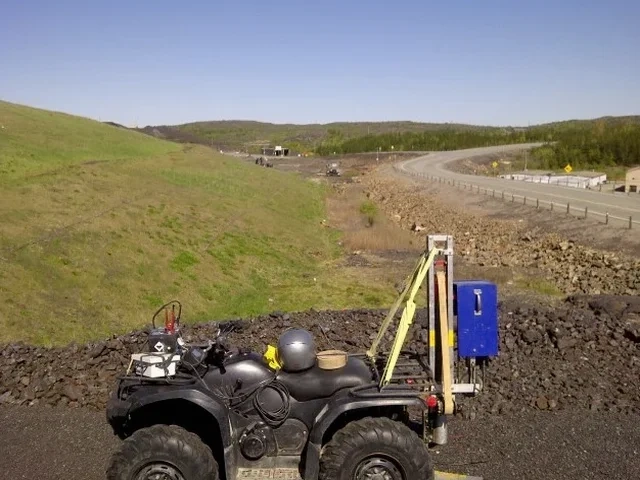
In Reading, compliance with BS 5930:2015+A1:2020 and the relevant parts of Eurocode 7 (BS EN 1997-2:2007) governs every ground investigation we undertake. The town’s geology, straddling the London Clay Formation to the north and the Seaford Chalk to the south with pockets of River Terrace Deposits along the Kennet floodplain, creates a mosaic of subsurface conditions where conventional boreholes alone often miss critical transitions. Seismic tomography provides the continuous spatial coverage that fills those gaps. By measuring compressional and shear wave velocities through the ground, we map the interface between dense chalk, overlying gravels, and any softened zones before a single footing is designed. The method proves particularly valuable on Thames-side redevelopment plots where buried paleochannels can lurk beneath apparently uniform site investigation data.
Local geotechnical context
Reading’s expansion from a Saxon settlement at the confluence of the Thames and Kennet into a major railway and technology hub has left a legacy of made ground, buried infrastructure, and undocumented fills across the town centre. The 19th-century industrial corridor along the Kennet saw extensive canalisation and later backfilling with variable materials—demolition rubble, ash, and reworked alluvium—that produce chaotic seismic velocity signatures. In our background, the most consequential risk on these sites is missing a sharp lateral transition between competent gravel and a soft-filled paleochannel. A foundation bearing on both materials without transition detailing will suffer differential settlement within the first few years of service. Seismic tomography maps these boundaries before they become a structural problem, giving the design team the cross-sections needed to zone the site correctly. On the chalk slopes around Caversham, the method also helps identify relic periglacial solifluction deposits that can creep under load.
Common questions
What depth can seismic tomography reliably image in Reading's geology?
For refraction surveys across the chalk and gravel terrain typical of Reading, we routinely achieve penetration to 30–50 metres below ground level using a 115-metre spread and accelerated weight-drop source. Reflection tomography can reach 80–100 metres where velocity contrasts are sufficient, though signal attenuation in the London Clay north of the Thames limits depth to around 60 metres in that formation.
Can seismic tomography detect dissolution cavities in the chalk beneath Reading?
Seismic tomography identifies the low-velocity anomalies associated with chalk dissolution features—zones of fractured, softened material or air-filled voids manifest as P-wave velocity drops below 1,200 m/s. However, the method provides a bulk velocity model rather than pinpointing individual small cavities. For sites where dissolution risk is the primary concern, we recommend combining a seismic tomography survey with targeted CPT testing to ground-truth anomalous zones detected in the tomogram.
What does a seismic tomography survey cost for a typical Reading residential development plot?
For a standard residential plot in the Reading area requiring two to three refraction profiles totalling roughly 300–400 lineal metres, the survey cost ranges from £1,850 to £4,450 depending on site access, the number of geophone spreads, and whether reflection processing is also required. We supply a fixed-price proposal after a desktop study of the site geology.
How does seismic tomography fit into a wider ground investigation for a Reading basement excavation?
For urban basement projects in Reading—particularly within the postcode areas RG1 and RG2 near the town centre—seismic tomography offers a non-intrusive first-stage screening that maps the bulk stiffness of the ground and the depth to competent chalk. The velocity model then informs the positioning of SPT boreholes and trial pits, ensuring they target the critical transitions rather than being spaced arbitrarily across the site.