← Home · Laboratory

Laboratory CBR Testing in Reading

Together, we solve the challenges of tomorrow.

LEARN MORE →

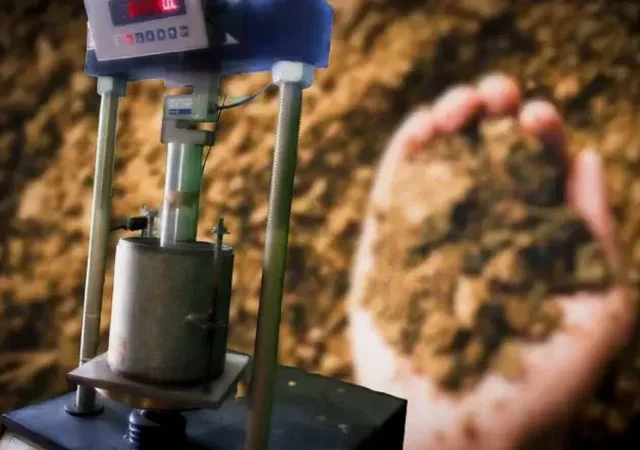
The clay-with-flints and London Clay that dominate Reading's geology demand careful pavement design. Wet winters saturate the subgrade. Summer drying shrinks it. Without a proper CBR value, you're guessing the pavement thickness. We run the BS 1377-4 CBR test in our temperature-controlled lab. Samples arrive from sites across Reading—from Green Park business estate to the new housing off Basingstoke Road. The plunger loads at 1.27 mm/min. We plot the force-penetration curve. You get the CBR at 2.5 mm and 5 mm. That single number drives your pavement design for roads, car parks, and hardstandings across the Thames Valley.

A single CBR value, properly tested to BS 1377-4, saves thousands in over-design or prevents premature pavement failure.
Methodology and scope

Reading sits at roughly 45 metres above sea level, straddling the River Kennet. The town's population has passed 174,000 and keeps growing. More people means more roads, more car parks, more industrial yards. Every one of those surfaces needs a subgrade assessment. Our CBR test covers both top and bottom of the sample. We soak the specimen for 96 hours to simulate worst-case field conditions—the water table here rises fast after a wet winter. The surcharge rings and swell measurement record exactly what the soil does when it gets saturated. For sites where the subgrade varies sharply, pairing the CBR with in-situ permeability testing helps track where water will weaken the formation. We report CBR values typically between 1% and 20% for local clays, though well-compacted granular fill can push past 30%.
Laboratory CBR Testing in Reading
Technical reference image — Reading

Local geotechnical context

London Clay in Reading can lose over 80% of its bearing capacity when saturated. We've seen samples where the soaked CBR drops below 2%, even though the unsoaked value looked fine. If you design with the unsoaked number, the pavement fails within two winters. The formation ends up pumping fines through the sub-base. Cracking follows. The other risk is misinterpreting the force-penetration curve. A concave-upward curve needs the tangent correction. Skip it and you get an artificially low CBR. Our lab technicians run this correction as standard. They also check for density variations across the specimen. A poorly compacted sample gives CBR numbers that don't represent the field.

Need a geotechnical assessment?

Reply within 24h.

Email: contact@geotechnical-engineering1.com

Technical parameters

ParameterTypical value
StandardBS 1377-4:1990
Specimen preparationProctor compaction at OMC
Soaking period96 hours submerged
Penetration rate1.27 mm/min
Surcharge weightEquivalent to pavement mass
Swell measurementTripod and dial gauge
ReportingCBR at 2.5 mm and 5.0 mm penetration

Related services

01

Standard CBR (soaked and unsoaked)

Full BS 1377-4 test. We compact the sample at optimum moisture content, soak it for four days, and measure swelling before penetration. You receive CBR values at both 2.5 mm and 5.0 mm penetration with the force-penetration plot.

02

CBR on undisturbed samples

For existing formations where you need the in-situ CBR without recompaction. We trim the sample directly into the CBR mould and test it at natural moisture content. Useful for forensic pavement investigations across Reading.

Relevant standards

BS 1377-4:1990, Eurocode 7 (BS EN 1997-2:2007), Specification for Highway Works (SHW) Series 600

Common questions

How much does a laboratory CBR test cost in Reading?

A standard BS 1377-4 CBR test runs between £90 and £160 per sample, depending on whether you need soaked and unsoaked values. Bulk pricing applies for five or more samples from the same site.

How long does the CBR test take from sample to results?

Three to five working days for a soaked test—the four-day soaking period drives the timeline. Unsoaked CBR can be turned around in 24 hours if the sample arrives compacted and ready. We email the report as a PDF with the force-penetration curve and all calculations shown.

Do I need a soaked or unsoaked CBR value for my pavement design?

Soaked. Always soaked. The Specification for Highway Works requires the four-day soaked CBR unless you can demonstrate the subgrade will never get wet. In Reading, with the water table close to surface in winter, that case almost never holds. We test both conditions so you have the full picture.

Location and service area

We serve projects in Reading and surrounding areas. More info.

View larger map